Know what it cost. Bill what you're owed.
Once the quote is won, the job keeps score: what you invoiced and what's still held, what you ordered and what arrived, what the crew cost and what the suppliers charged - all read back against what you priced.
At month-end there's one pack for the accountant, and a VAT201 working paper if you're a South African VAT vendor. No general ledger, no bank feed, and nothing guessed.
- Retention withheld per draw
- Expected · Actual · Variance on every job
- A month-end pack your bookkeeper posts from

Invoice the way the contract says.
Deposit, progress and final draws off the accepted quote, reconciled to the cent. Nothing can bill past the agreed total.
Set a retention rate once, before the customer accepts, and every draw bills net of it:
- Payable now R90 000 + VAT
- Held as retention R10 000
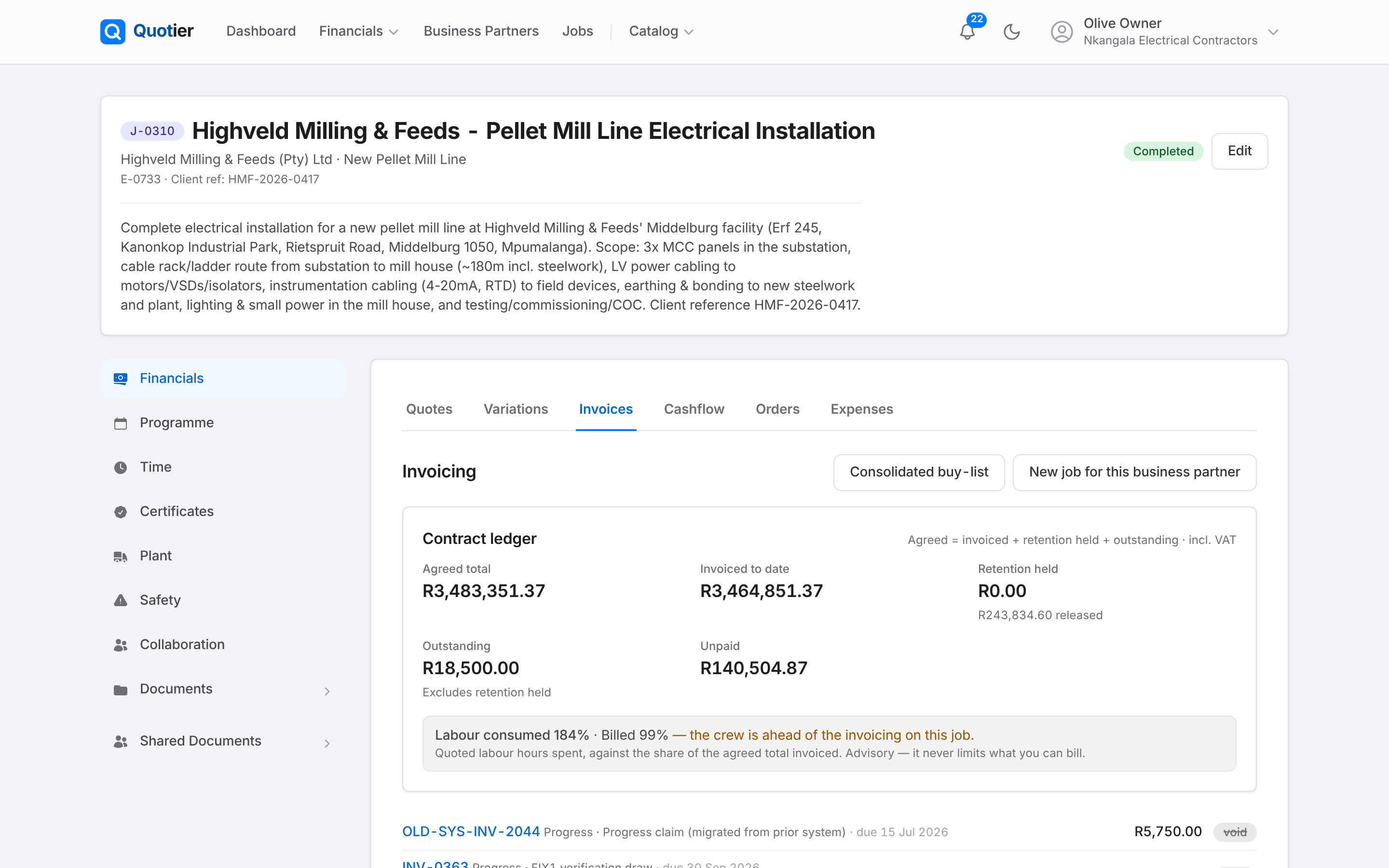
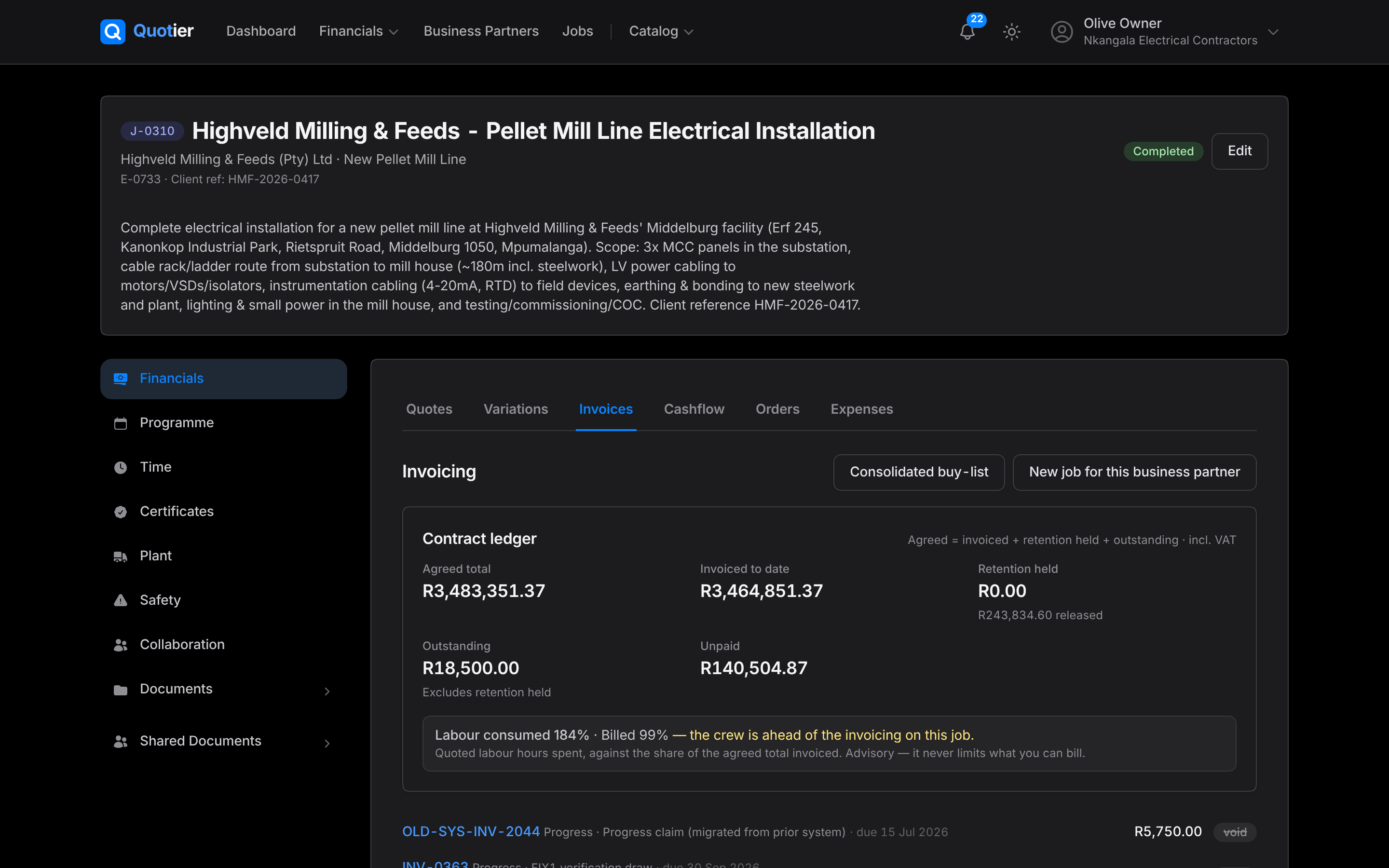
The contract ledger, ex VAT
Agreed R612 400.00
- Invoiced to date
- Retention held
- Outstanding
- Invoiced to date
- R0.00
- Retention held
- R0.00
- Outstanding
- R612 400.00
No draw yet. The four figures reconcile from the first day: agreed equals invoiced plus held plus outstanding, after every step.
- Invoiced to date
- R183 720.00
- Retention held
- R0.00
- Outstanding
- R428 680.00
- Claimed
- R183 720.00
- Withheld
- off for this draw
- Payable
- R183 720.00
- Invoiced to date
- R404 184.00
- Retention held
- R24 496.00
- Outstanding
- R183 720.00
- Claimed
- R244 960.00
- Withheld
- R24 496.00
- Payable
- R220 464.00
- Invoiced to date
- R514 416.00
- Retention held
- R36 744.00
- Outstanding
- R61 240.00
- Claimed
- R122 480.00
- Withheld
- R12 248.00
- Payable
- R110 232.00
- Invoiced to date
- R569 532.00
- Retention held
- R42 868.00
- Outstanding
- R0.00
- Claimed
- R61 240.00
- Withheld
- R6 124.00
- Payable
- R55 116.00
- Invoiced to date
- R612 400.00
- Retention held
- R0.00
- Outstanding
- R0.00
- Release invoice
- R42 868.00
- Withheld
- none on a release
- Payable
- R42 868.00
-
Step 1 of 6
Accepted.
The customer accepts Q-0512 against their order number and the job's ledger opens: R612 400.00 agreed, nothing invoiced, nothing held, all of it outstanding. Those four figures reconcile after every step below.
-
Step 2 of 6
A 30% deposit - retention off.
Many contracts exempt the deposit, so you switch retention off for this draw at the point of issue. The invoice bills R183 720.00 in full, and the frozen columns record that nothing was withheld.
-
Step 3 of 6
A 40% progress claim, net of 10%.
The claim is R244 960.00. At the contract's 10% the invoice bills R220 464.00 and R24 496.00 moves into held - claimed, withheld and payable all print on the customer's document.
-
Step 4 of 6
A 20% progress claim.
Same rule, same rate, which the accepted quote fixed: R122 480.00 claimed, R12 248.00 held, R110 232.00 billed. A draw that would bill past the agreed total is refused, not warned about.
-
Step 5 of 6
The final draw closes the billing - not the retention.
It bills exactly what is still outstanding, R61 240.00, net of its own R6 124.00. Outstanding is now zero, and the ledger still says R42 868.00 is held. The panel remembers the defects period.
-
Step 6 of 6
The release brings it in.
When the release falls due, one more invoice bills what is held - capped at R42 868.00, withholding nothing on itself. Invoiced now equals agreed, and the contract is closed to the cent.
Turn it off per draw - many contracts exempt the deposit. Release it when it falls due, capped at what's held, and the job's panel says when the defects period has passed with money still on the table. How retention works.
A callout with no quote bills direct - or by the hour, straight off the timesheet, and an hour that's been billed can't be billed twice.
A standing scope raises its own draft each period; you issue it. Where the mine certifies your claim, a payment application records what you applied for against what was certified - so under-certification is a figure, not an argument.
Whether output VAT is due on retained money before the release is invoiced is a question for your accountant. Quotier declares VAT on each invoice, on its own amount, in the period of its own date - and makes no claim either way.

Then get paid the way customers actually pay.
Your bank, account holder, account number and branch code freeze onto every invoice at the moment you issue it - so the demand to pay carries the way to pay it. A quote never does: an offer is not a demand for payment.
Money arrives in pieces. Record each one - amount, the day it landed, the EFT reference - and everything that counts what you're owed counts the remainder: the job panel, the ageing, the statement. An over-payment is refused rather than parked.
- A reminder that's a button, never a robot. Chase an invoice from the board, the job or the invoice itself; it goes on your letterhead, says what's still outstanding, and Quotier records when you last chased. No schedule, no auto-dunning - who gets nudged is a relationship call.
- A statement your customer can open. Every open item with what's paid and what's left, the ageing, the payments received in the last 90 days. Printed from the browser, emailed, or sent as a link that needs no login and expires after 60 days. Credit notes are listed on it, never subtracted - nothing here knows which invoice a credit was applied against, so it will not guess.
- A credit note for money already received. Issued against a paid invoice, with a reason that prints, dated the day you issue it - so the correction lands in that period, not the one you already filed. An unpaid invoice is voided and re-issued instead.
- The right document to the right person. A contact per business partner, with the invoice routed to accounts and the quote to the buyer.
Did the job make money? Ask before the accountant does.
Expected cost comes off the accepted quote - crew hours at cost rates, products at cost price, the subcontractor you priced in.
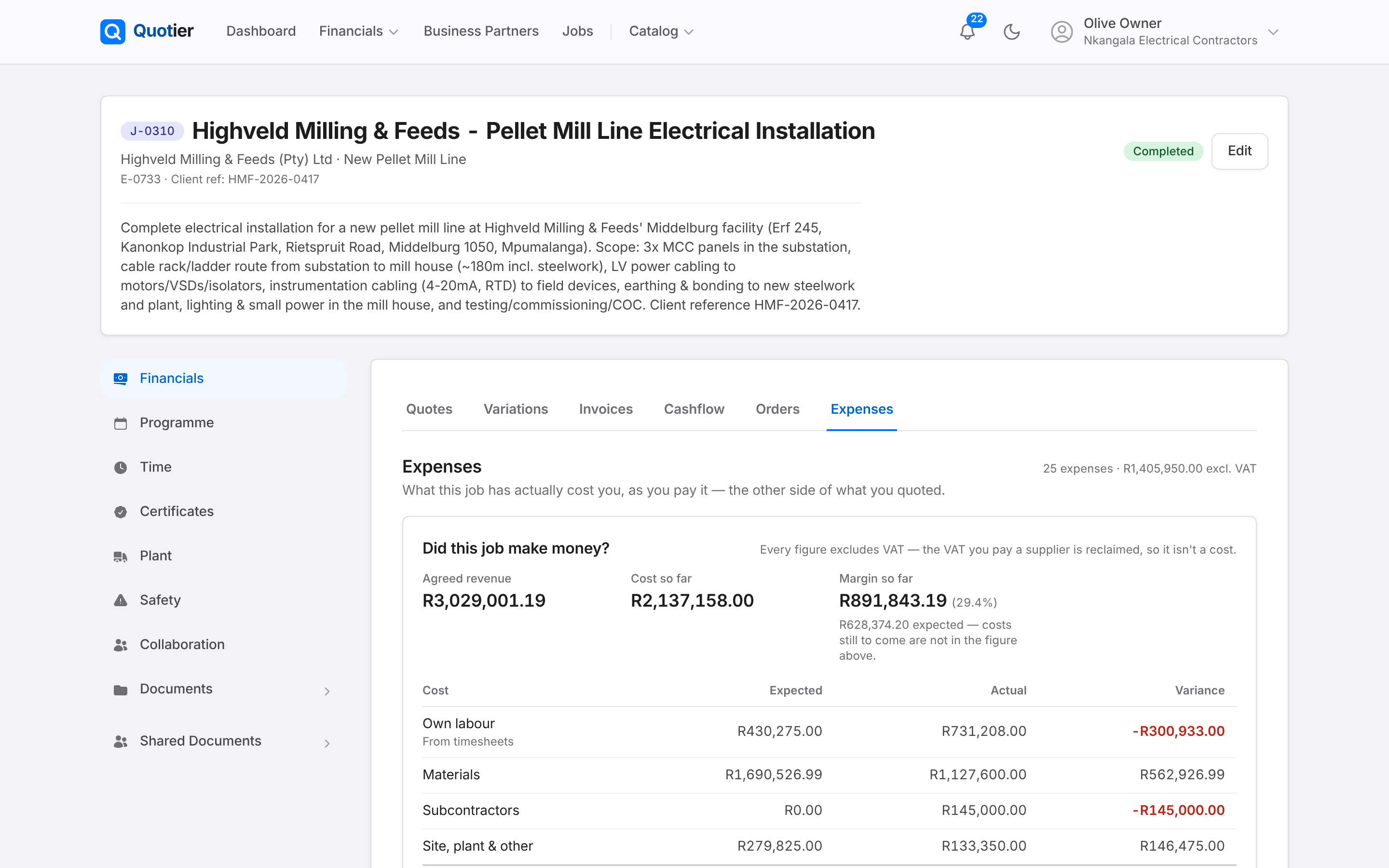
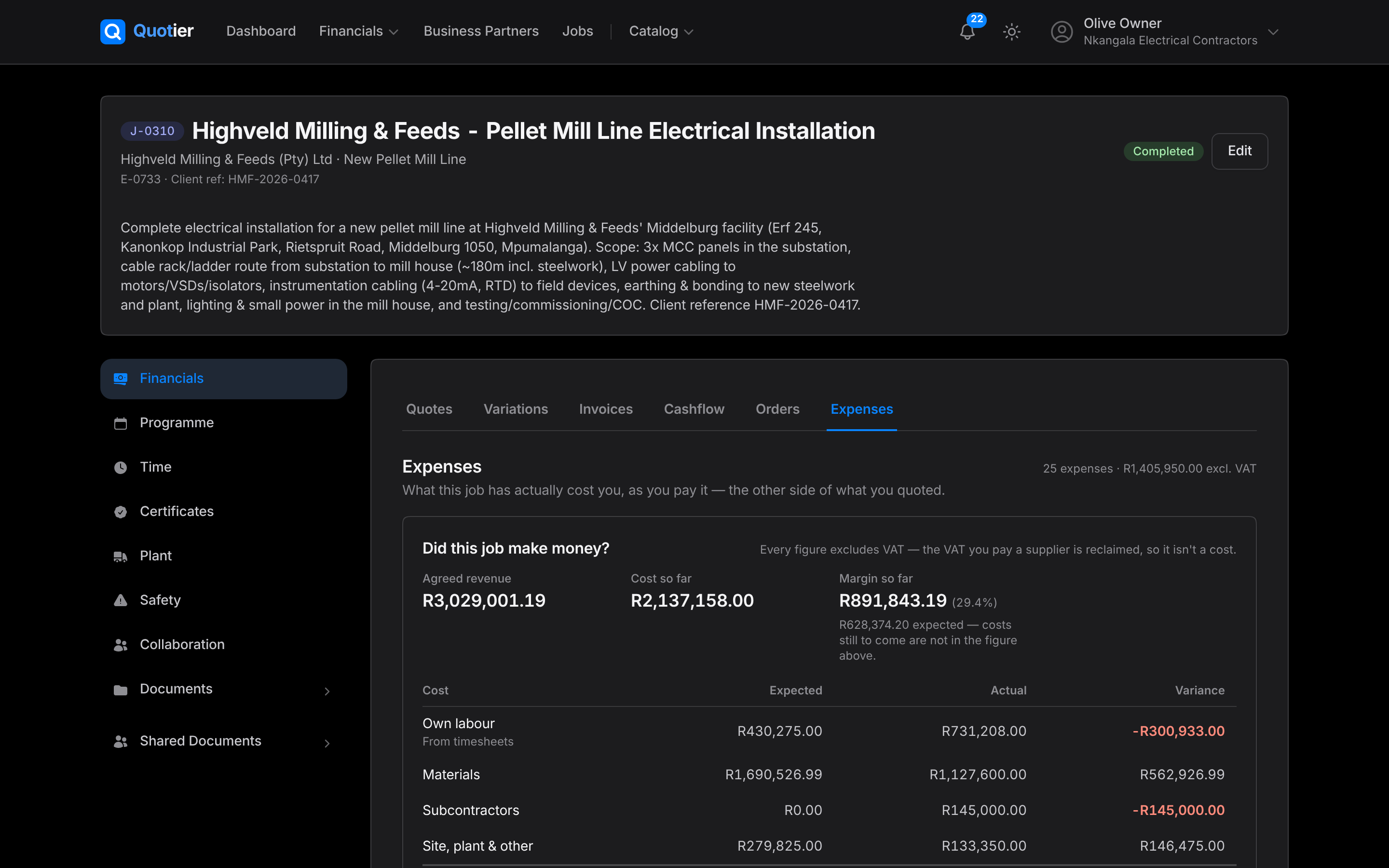
Actual cost is what you captured: expenses with the supplier's invoice attached, hours off the timesheet, the subcontractor's invoice that came up the chain. The two never blend - you always see Expected · Actual · Variance, so a job that's bleeding tells you which half.
Log a products expense off the job's buy-list and the cable you quoted and the cable you bought become one line: Costed · Logged · Left. Raise a purchase order off the same list and the card reads Ordered · Received · Invoiced. How purchase orders work
Purchase orders and goods received are the Procurement module. There is no stock: Quotier records what you ordered and what arrived, not where the surplus went.
Expected · Actual · Variance, on every job
Expected
R412 300.00
Actual
R543 810.00
Variance
-R131 510.00
Five questions, in the order you ask them.
The Financials page is every job's money summed across the company: what came in, what went out, what's owed, and which jobs are thinnest - worst margin first, because "which jobs are bleeding" is the question and a date-ordered report is not the answer.
Every figure is labelled with its own basis - ex-VAT where you reclaim input tax, gross where cash left the bank - and none of them pretends to be a set of books.
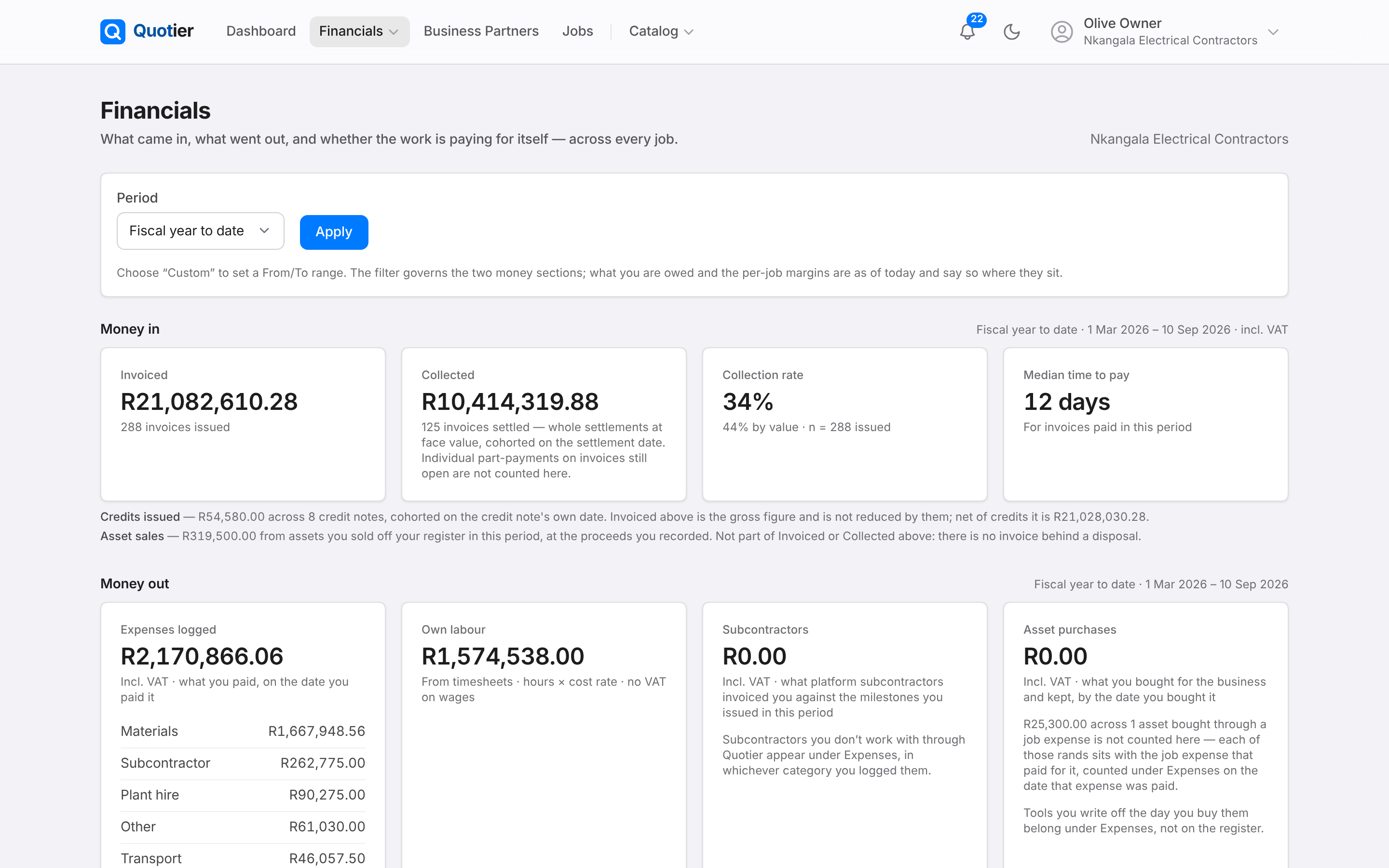
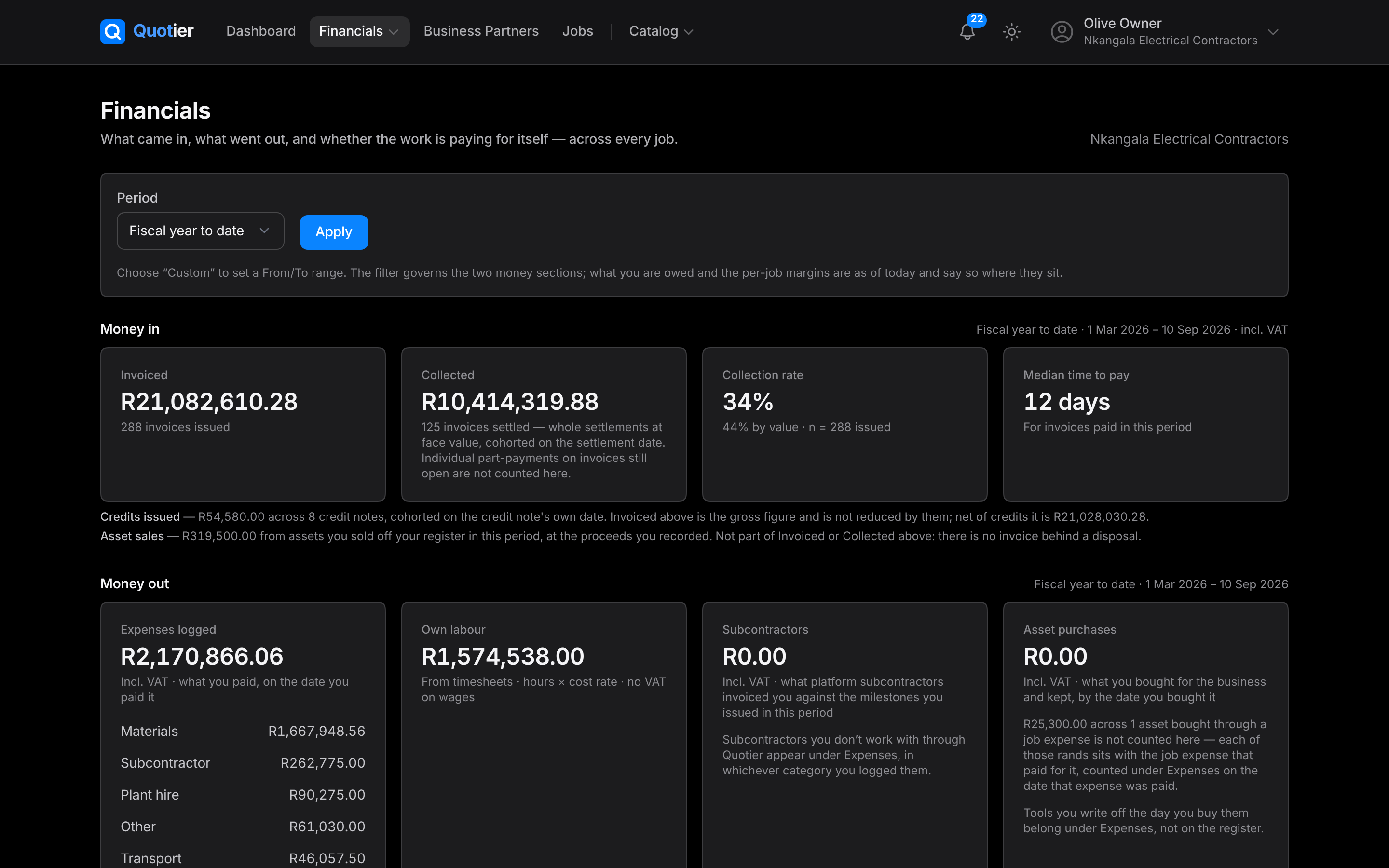
The fifth question is a list, not a figure: which jobs are thinnest, worst margin first. A margin belongs to a job, so there is no company-wide one to print here.
Demo organisation, fiscal year to date.

The crew booked the hours. The suppliers sent the invoices. Now somebody has to close the month.
Hand your accountant a pack, not a shoebox.
Quotier is not accounting software and never will be. It puts every document the month produced into one file a bookkeeper can post from - and refuses, in words, to do the parts that are theirs. A refusal that names nobody is just a blank.
Month-end pack
Gross wages
VAT201 working paper
Book depreciation
Invent an account code.
Compute PAYE, UIF, SDL or ETI.
Submit anything to SARS.
Reconcile a bank statement.
Guess a wear-and-tear rate.
Where a SARS detail could not be verified for this build - which months your category's periods end in, the due date - the working paper prints it as something for you to check against your registration certificate, not as a figure it decided.
Each of these has a page of its own
What the money half looks like up close, including what Quotier deliberately refuses to do in each area.
Invoicing
Invoice off the quote you won, not off a blank page.
Read moreRetention
Retention the invoice, the ledger and the job all agree on.
Read morePurchase orders
Purchase order software for industrial contractors
Read moreSupplier quotes
Supplier quote comparison for industrial contractors
Read moreStraight answers
Is Quotier accounting software?
No. There's no general ledger, no journals and no bank reconciliation, and the Financials page says so at the bottom. Every figure is a roll-up of the quotes, invoices, timesheets and expenses you captured. Your accountant's books stay the authority; the month-end pack is what you hand them.
Does the VAT201 working paper file my return?
No. It assembles a period's output and input schedules from the documents you hold and prints them box by box as a capture aid for e-Filing. Nothing is submitted to SARS. Where a box can't be honestly populated from your data - imported services, bad debts, change of use - it says so in words rather than printing a zero. It's only offered to a South African organisation with a VAT number.
How does retention work?
Set the rate once on the quote before the customer accepts. Every draw then bills net, with claimed, withheld and payable printed on the invoice, and you can switch it off per draw. Releasing it is an ordinary progress invoice flagged as a release, capped at what's held, and the job panel tracks the defects period and says when a release is due. Whether output VAT is due on retained money earlier than that is a question for your accountant; Quotier makes no claim either way.
Can I correct a paid invoice?
With a credit note. It's issued against a paid invoice, carries a reason that prints, and is dated the day you issue it - so the correction lands in that period, not the one you already filed. An unpaid invoice is voided and re-issued instead.
Do you see my bank account?
No. Payments are what you record - the amount, the date it arrived, the EFT reference. Quotier never connects to a bank and reconciles nothing, and the panel says so under the form.
Does it run payroll?
No. The gross-wages export is hours and gross pay per crew member, for you to hand to your payroll provider. No PAYE, UIF, SDL or ETI - those change with legislation Quotier doesn't track.
Bill it, cost it, and know.
Start free and add Invoicing the month you first need a retention draw, or book a 20-minute demo and we'll walk a real job from quote to month-end.